

CI setup
Run ci-parity in GitHub Actions: annotations on pull requests, code scanning alerts, or counts for a later step.
flowchart LR
    pr["Pull request"] --> job["Workflow job:<br/>checkout, then<br/>jimmykurian/ci-parity@v0"]
    job -->|"format: github<br/>(default)"| ann["Annotations on the<br/>changed workflow lines"]
    job -->|"format: sarif"| up["upload-sarif"] --> cs["Code scanning alerts,<br/>each linked to its rule page"]
    job -->|"fail-on-error: false"| out["Outputs: errors,<br/>warnings, tolerated"]
Annotations on pull requests
Section titled “Annotations on pull requests”The action’s default format, github, turns each finding into an annotation on the
workflow line that caused it. The job fails when there are errors.
name: ci-parityon: [pull_request]
jobs:  ci-parity:    runs-on: ubuntu-latest    permissions:      contents: read    steps:      - uses: actions/checkout@v7      - uses: jimmykurian/ci-parity@v0
On the pull request, each finding appears on its line in Files changed:
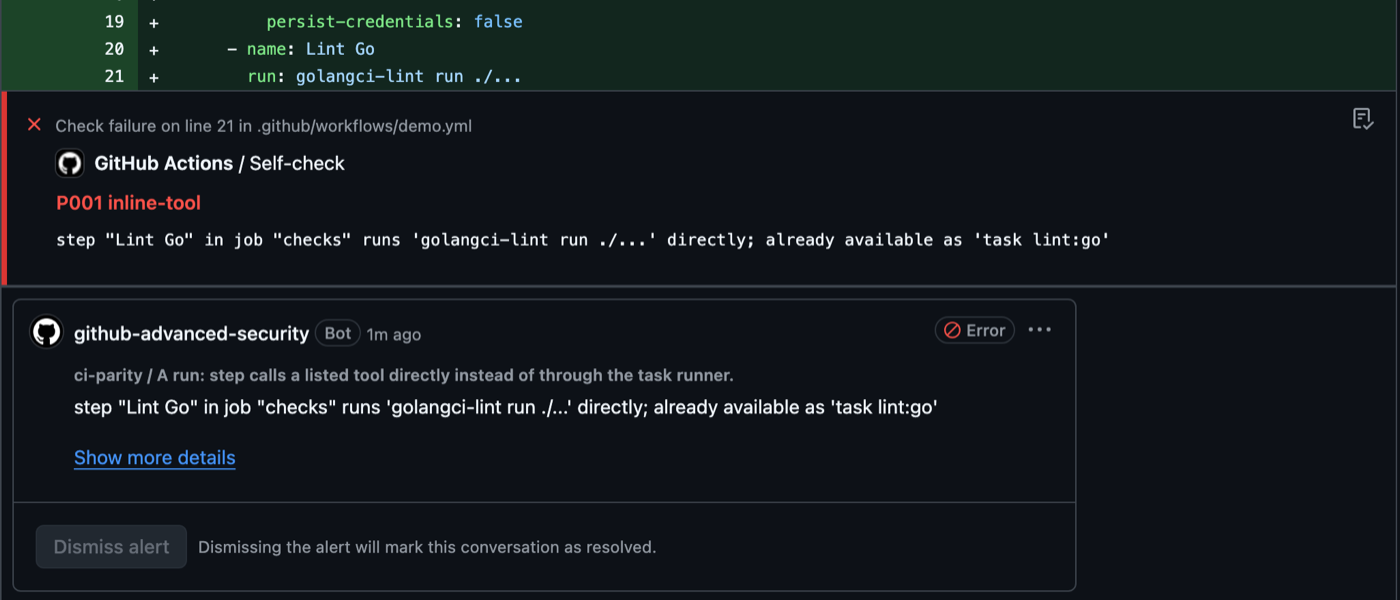
Each annotation is one line of workflow commands in the job log:
::error file=.github/workflows/ci.yml,line=7,col=14,title=P001 inline-tool::step "Test" in job "web" runs 'pnpm test' directly; already available as 'task test'Paths are relative to working-directory, so annotations line up only when it’s the
root of the checked-out repository (the default).
Code scanning
Section titled “Code scanning”With format: sarif, the action writes a SARIF log
and gives its path as the sarif-file output. Upload it, and the findings appear in the
repository’s Security tab as code scanning alerts, each linked to its rule’s page here.
jobs: ci-parity: runs-on: ubuntu-latest permissions: contents: read security-events: write steps: - uses: actions/checkout@v7 - uses: jimmykurian/ci-parity@v0 id: parity with: format: sarif fail-on-error: false - uses: github/codeql-action/upload-sarif@v4 with: sarif_file: ${{ steps.parity.outputs.sarif-file }} category: ci-parityOn a pull request, the code scanning check lists the new alerts, each on its line:
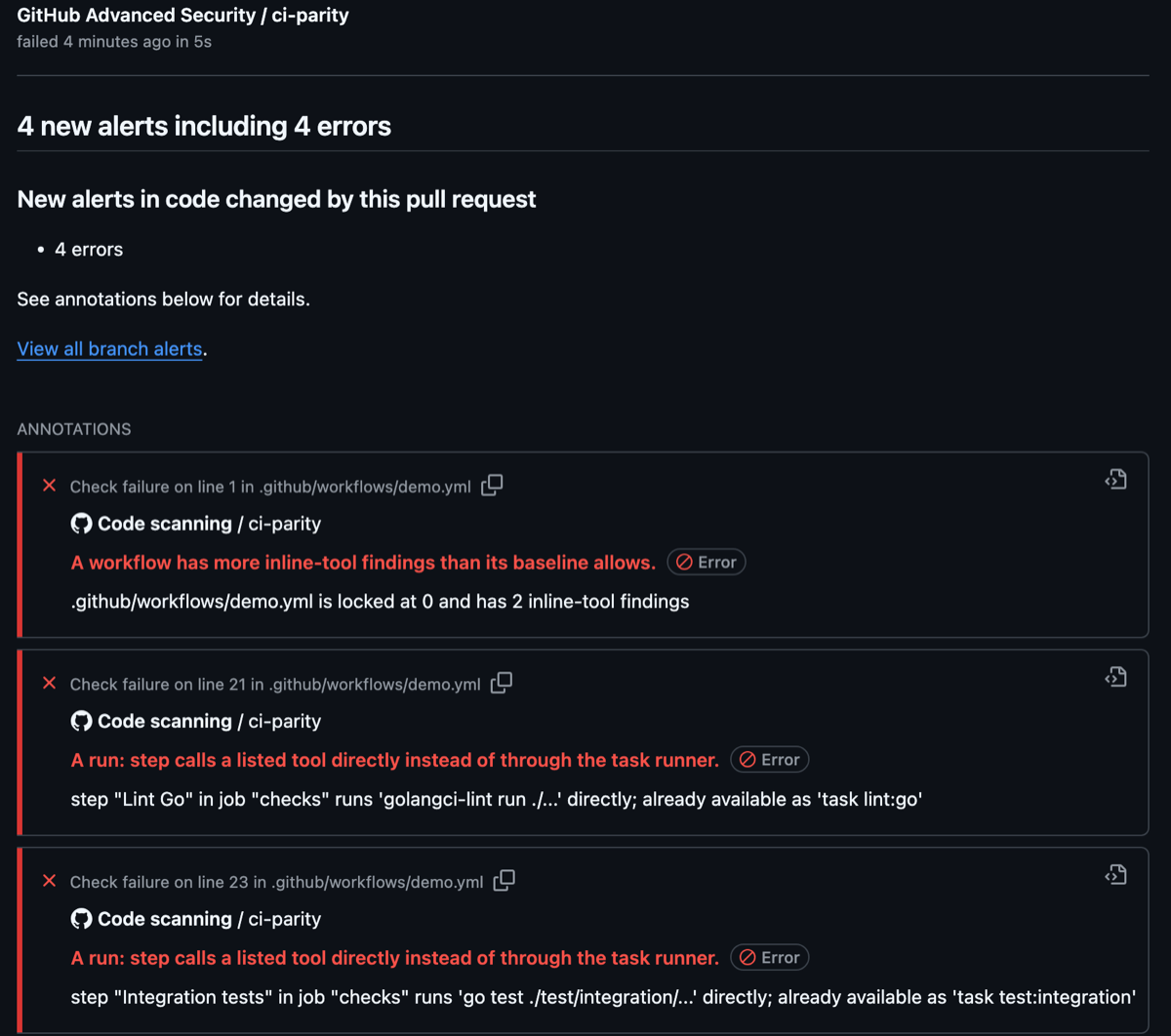
- Errors are
erroralerts, warningswarning, and tolerated findingsnote. - An allowed finding is uploaded as suppressed in source, with its reason, so code scanning shows it as dismissed.
- Each alert carries a fingerprint built from the rule, file, job, step and command, so moving lines doesn’t open a new one.
- With
fail-on-error: false, the job succeeds and code scanning reports the findings; leave ittrueto also fail the job.
Code scanning is free for public repositories; private ones need GitHub Advanced Security.
Counts for later steps
Section titled “Counts for later steps”With fail-on-error: false, the step always succeeds and its outputs carry the counts:
- uses: jimmykurian/ci-parity@v0 id: parity with: fail-on-error: false - if: steps.parity.outputs.errors != '0' run: echo "::warning::${{ steps.parity.outputs.errors }} ci-parity errors"The outputs are errors, warnings, tolerated and sarif-file; the
action reference has every input and output. For your own
tooling, ci-parity check --format json prints a document whose shape changes only with
its version; see the output formats.
A baseline in CI
Section titled “A baseline in CI”Commit .ci-parity-baseline.json, and the action uses it like check does: tolerated
findings pass, and a rise fails with P004. Set strict: true to
ignore the baseline, for example in a scheduled job that tracks what’s left. See
Adopting with a baseline.
See also
Section titled “See also”Last reviewed: 2026-10-28